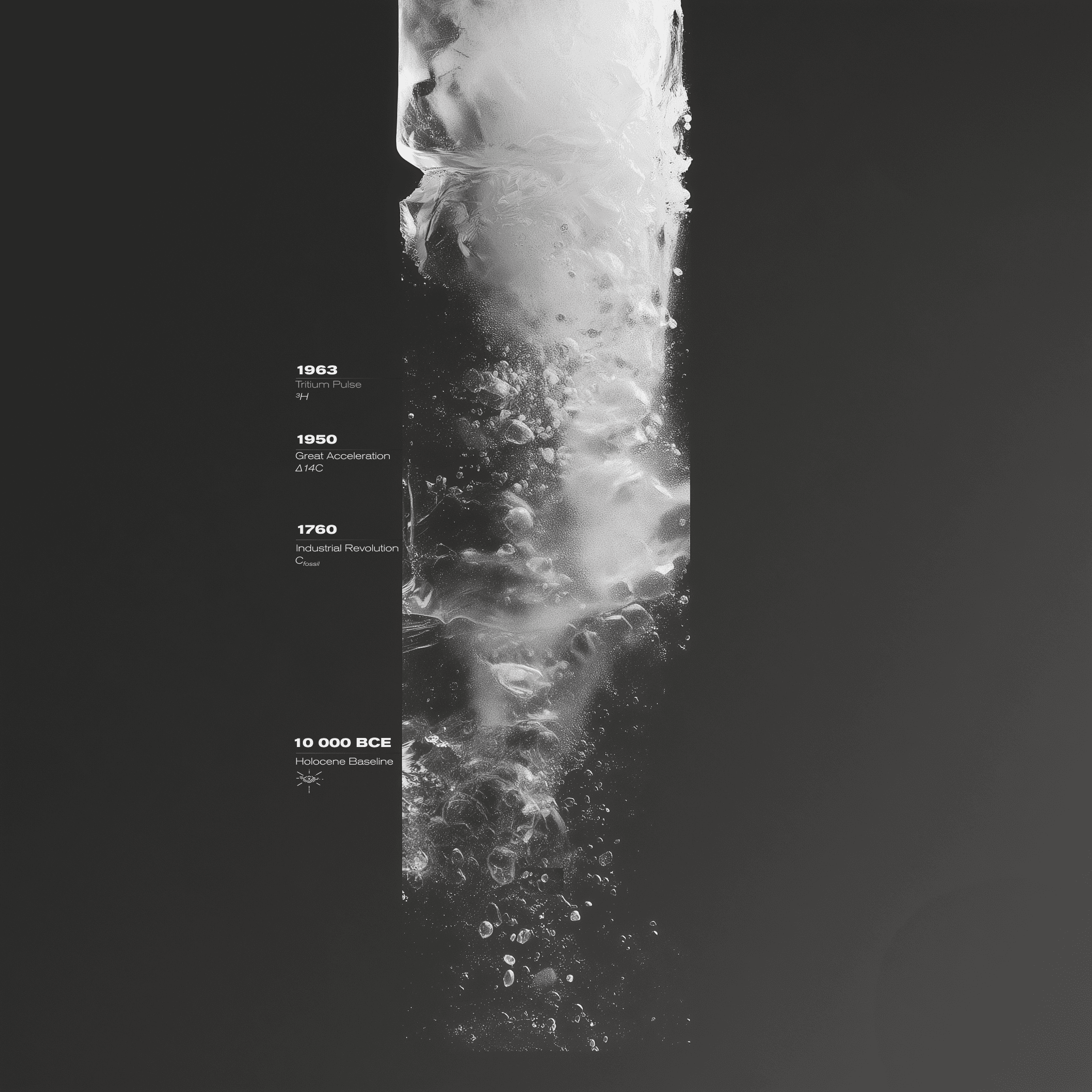

Some data disappears. A glacier's state before it retreats, the composition of an ocean floor before it's mined, these aren't datasets that a well-funded competitor can simply go out and rebuild.
Disappearing Data: The Physical World's Answer to Unreplicable Competitive Advantage
The Vanishing Site
The idea of a data moat is shifting. It used to be about volume, how many users feed your service. That model works well in SaaS and consumer platforms where network effects do the compounding for you. But in Earth and space exploration, a different kind of defensibility is taking shape, and it has less to do with how much data you have and more to do with whether anyone else can ever get it again.
Some data disappears. A glacier's state before it retreats, the composition of an ocean floor before it's mined, these aren't datasets that a well-funded competitor can simply go out and rebuild. The window was open, and now it's closed. That temporal and physical scarcity is what makes this kind of data fundamentally different from anything accumulated through software scale. It can't be replicated because the conditions that produced it no longer exist.
But what it means economically, and how it changes the way venture capital and founders should think about defensibility in frontier exploration.
Two Modalities of Disappearing Data
It's worth distinguishing between data that disappears because nature made it so and data that's scarce because someone chose to make it scarce.
Type 1: Naturally Ephemeral Data
Nature routinely destroys the information we need most to understand it. In the Antarctic, researchers work against the clock to extract ice cores, ancient atmosphere trapped in air bubbles, before glacial movement compromises the record. As temperatures rise and glaciers retreat, years of data are being lost to melting and sublimation. The source material is literally disappearing.
This creates a kind of first-mover advantage that has no parallel in software or digital platforms. Once a glacier has retreated or a core site has degraded, no amount of funding or technology allows a competitor to go back and collect what was there. Whoever captured it holds something that can never be reproduced.
Type 2: Artificially Scarce Data
Some companies are acquiring data from failed ventures and dissolved companies, building libraries that no one else has access to. Proprietary surveys, sensor readings, failed extraction data that were never published. The original company went under, the data survived, and someone bought it.
The scarcity here is purely artificial. Competitors are locked out by ownership.
Investing in Irreplaceability: The Venture Capital Perspective
Venture capital is starting to pay attention to disappearing data moats because they offer something software moats don't: terminal value rooted in irreversibility. The defensibility shifts from the model to the training data, and unreplicable data is where the insight lives.
The first-mover dynamics here are tied to physical capex, not code. Mary Meeker's 2024 AI report notes that "Physical World AI" is scaling faster than software-only AI because real-world deployment generates proprietary datasets . Every mile driven by a Tesla, every acre farmed by Carbon Robotics creates data no one else has. In frontier exploration this is even more pronounced because entry costs are physical.
And unlike a SaaS startup that can pivot its codebase, an exploration company's investment is sunk into physical data capture. But if that data is disappearing, the sunk cost becomes a fixed asset with a long service life. The money is spent and the data can never be collected again. That changes the economics entirely.
Case Study
KoBold Metals (extracting critical minerals), valued at over $1 billion and backed by Breakthrough Energy Ventures and a16z, is a clear example of this. Their moat isn't the algorithm. It's exclusive access to historical exploration records obtained through commercial agreements with major mining companies, combined with expert insights and increasing sensor/stellite data.
Much of this data comes from "failed" projects, drilling samples and seismic lines from decades ago that were deemed non-commercial at the time.
Competitive Advantage Framework
The core difference between a traditional data moat and a disappearing data moat lies in the relationship between the data and its physical origin.
Comparison of Moat Defensibility
Moat Attribute | Traditional (e.g., SaaS) | Disappearing (e.g., Earth/Space) |
Source | User-generated/Network effects | Physical environment/Temporal events |
Reproducibility | High (if a competitor gets more users) | Zero (if the physical source is altered) |
Scale Advantage | Logarithmic (value per user) | Linear/Exponential (value per unique epoch) |
Legal Protection | Copyright/Trade Secret | Physical Access/Sovereignty/Contracts |
For this kind of moat to hold, three things need to be true.
1. The data has to describe something that is changing or disappearing, a state that won't exist again.
2. The capture has to require physical presence somewhere difficult or expensive to reach.
3. The measurement itself has to be tied to conditions that can't be recreated, whether that's a specific weather pattern, a political window of access, or a geological state that has since shifted
But proving that to an investor requires more than a claim. The defensibility framework has to be embedded in how you present the opportunity, from the data room to the pitch deck.
Investor Due Diligence
When a founder claims a moat based on disappearing or unreplicable data, venture capital due diligence must be rigorous in validating that the data is truly "physically unavailable" rather than just "expensive to collect." But even more important, what can we do we the data? Is it useful to make preductions? How does that data improves efficiency?
The strategy has real vulnerabilities
Technological leapfrogging.
A moat built on resolution can collapse overnight if sensor costs drop or a new sensing modality emerges. If your advantage is high-resolution 2D satellite imagery, a competitor deploying low-cost 3D LiDAR could make your entire archive less relevant. Neuromorphic sensing is a live example of this threat, it redefines what counts as high-fidelity and changes the frame entirely.
Regulatory and ethical push back
There is a growing legal push toward data democratization. The OPEN Government Data Act and lawsuits against the EPA's "secret science" rules suggest that privatizing data with public good implications, like climate or environmental safety, will face legal challenges. Antitrust scrutiny has largely ignored data hoarding because it focuses on prices, but that may change as the costs of lost information become harder to ignore.
Economics of holding dead data
Buying failed exploration data assumes it will eventually be valuable. But commodity prices fluctuate, and the cost of holding and processing that data may exceed what it's ever worth . If the AI can't find the signal in the noise, the stock of knowledge becomes a graveyard.
Conclusion: The Real World Still Wins
The transition from digital abundance back to physical scarcity is the defining trend for the next decade of deep-tech investing.
Takeaway for VCs: If the data can be generated it is a commodity; if it requires a thermal drill in East Antarctica, it is an asset.
Takeaway for Founders: Architect your data using "hierarchical classification" to ensure your records of disappearing physical realities become the definitive global standard.
If you're building on disappearing data and need help structuring the investment narrative around it I’ll be your strategic partner.
References
Academic & Legal References
Day, G., & Stemler, A. (2020). Infracompetitive privacy. Iowa Law Review, 105(61), 61-106.
Iliev, V. (2025). Event-based neuromorphic sensing: Redefining high-fidelity in orbital data. PubMed Central (PMC), PMC12526923. https://pmc.ncbi.nlm.nih.gov/articles/PMC12526923/
Zuidema, C., et al. (2021). Replication across space and time must be weak in the social and environmental sciences. Proceedings of the National Academy of Sciences (PNAS), 118(26). https://www.pnas.org/doi/10.1073/pnas.2015759118
Economic & Institutional Reports
Central Bank of Chile. (2013). Investment in Mining Exploration in Chilean National Accounts. Meeting of Group of Experts on National Accounts, 12th Session, Geneva. Supporting paper No. 1.
Tadros, F., & Svensson, K. (2011). Using Taxation to Enable a Fair and Thriving Mining Industry. Investment Climate in Practice: Business Taxation, No. 59792. World Bank Group.
Industry Analysis & Policy Briefs
Harvard University. (2025). The Trump administration’s on open access to research and federal data archives. Berkman Klein Center for Internet & Society. https://cyber.harvard.edu/hoap/The_Trump_administrations_on_open_access_to_research
Meeker, M. (2024). Physical World AI and Capital Intensity. Bond Capital. (As referenced in SaaStr: The top 10 learnings from Mary Meeker’s latest report on AI). https://www.saastr.com/the-top-10-learnings-from-mary-meekers-latest-report-on-ai/
Y Combinator / Hacker News. (2025). Strategic Information Vacuums: Purging of Federal Digital Assets. Hacker News, Item 42897696. https://news.ycombinator.com/item?id=42897696
Core Conceptual References
Antarctic Glaciers. (2025). Ice Cores and the Temporal Scarcity of Atmospheric Records. (As cited in Disappearing Data Report).
Metals Economics Group (MEG). (2013). Corporate Exploration Strategies (CES): Annual Study on Nonferrous Budgets.
Ostrom Workshop / Indiana University. (2020). Data Harvesting and Platform Monopolization. (As cited in Day & Stemler research).
Turn your phone sideways to read the charts. They are best on a desktop.
Published by House of Hōma OÜ, registered in Estonia.