In 2004 the state declared them useful, and they stopped being waste
Why China?
“I don’t want to hear anything more about radioactivity. Buy whatever you need, but I will not allow a single radioactive product.”
Jean-René Fourtou, head of Rhône-Poulenc.
Rhône-Poulenc went looking for a non-radioactive feed. It asked Norway, India and China. The Norwegians supplied, at a high price. Then China made an offer nobody could refuse.
“We should have kept the diversity of our supplies,” said Jean-Paul Tognet, the company’s former industrial and raw materials director.
That thing that caused all the trouble is still sitting in sheds in La Rochelle. Thirty-one thousand tonnes of thorium compounds.
Who are these people?
Who is who
Rhône-Poulenc was a French chemical group. It bought monazite sand, a mineral that has rare earths and thorium. It separated the two so the rare earths could be sold.
La Rochelle is their factory. It is still active.
Rhodia is the chemical arm that came out of Rhône-Poulenc. It inherited the rare-earth business, now operated by Rhodia Opérations.
Much later Solvay, a Belgian group, absorbed Rhodia. They didn’t change the names. That is why Andra[1] writes Solvay and the prefecture writes Rhodia for the same site.
One more thing, because the numbers in this article will look wrong otherwise.
The thorium is weighed two different ways. Until 2006 the state published the weight of the compounds, like thorium nitrate and thorium hydroxide. From 2009 it published the weight of the thorium inside them instead. The national figure went from 33,300 tonnes to 9,399. This risks falsely suggesting that roughly 24 tonnes of material has left the national inventory.
The beach
Two years after Chernobyl nobody trusted an official number about radiation.
The local greens asked for numbers on the plant’s discharge pipe, which emptied onto the beach at Port Neuf. The health ministry’s radiation service had the monopoly on official check[3] and gave them nothing. So they asked CRIIRAD[2], a laboratory set up after Chernobyl to break exactly that monopoly.
In March 1988, a woman walking the beach with a radiometer measured 1,000 counts per second at the outfall. A man in a white coat and green rubber gloves sampled half a liter of effluent from the pipe and took a sand core. In August, they returned to collect sediment pellets 50 meters away that measured over 500,000 becquerels per kilogram, with Thorium-228 exceeding 100,000 (CRIIRAD bulletin, not the article).
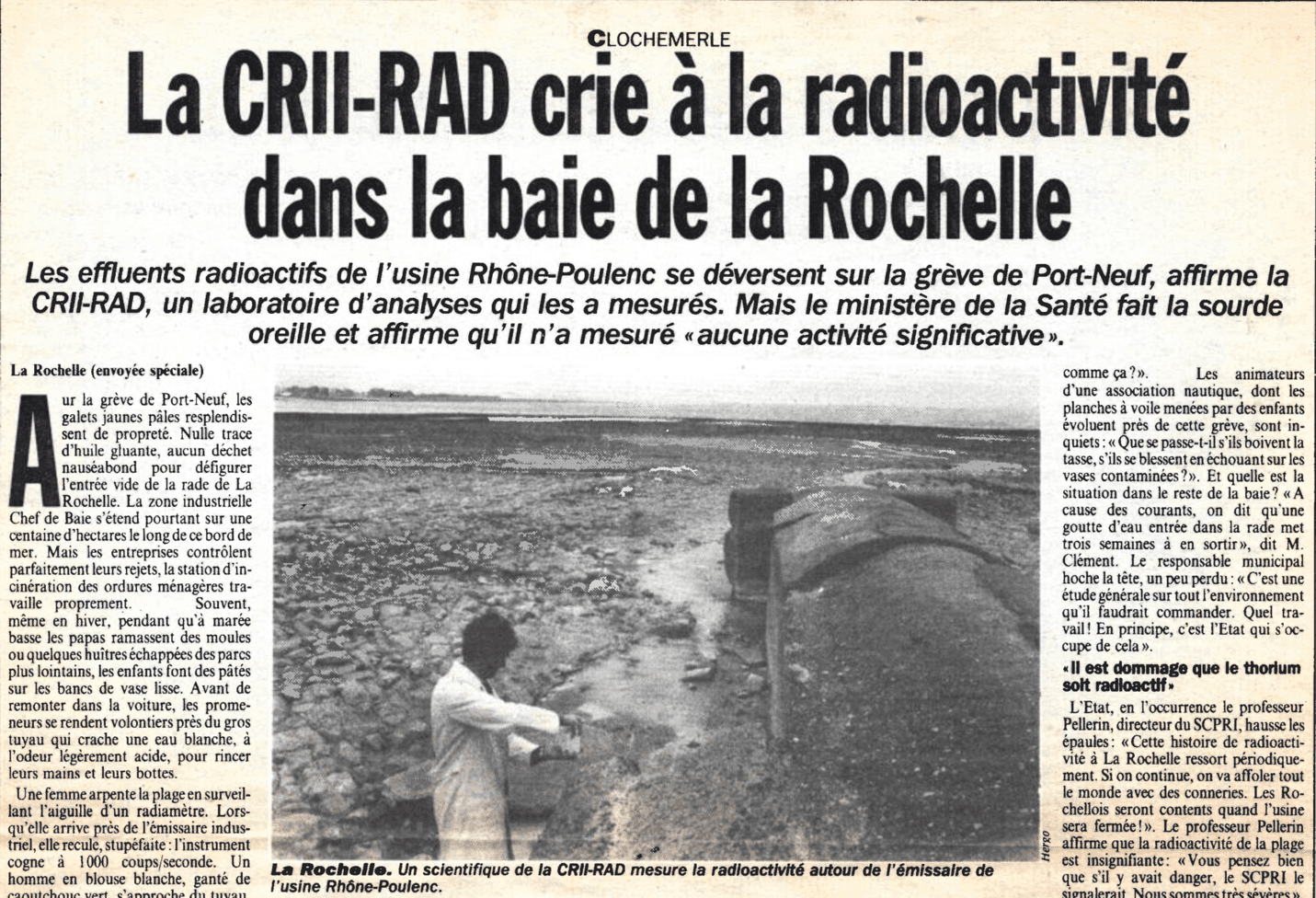
The press reports CRIIRAD's measurements on the beach at Port Neuf. The health ministry answered that it had measured no significant activity.
The ministry’s monthly bulletins, under the headings Thorium 228 and Radium 228, says: no significant activity.
Its director was asked about it. He said:
“This radioactivity business at La Rochelle comes up periodically. If we keep this up we are going to panic everyone with nonsense.”
He didn’t say nonsense. The French version of it is more explicit. He was the man who was accused of downplaying the effect of radioactive cloud over France caused by Chernobyl.
Committees formed. Public meetings chanted that Rhône-Poulenc was an atomic timebomb. A member of parliament came twice and was met with loudhailers. Management, in Tognet’s words, wanted to pull the plug. The controversy almost closed the plant.
Then Fourtou said the sentence.
So what did they stop?
Stop and promise
In 1993 they stopped putting the residue into the port. Until then the ordinary solid residue had gone, with other materials, into filling a zone inside the La Pallice port installations. About 50,000 cubic metres of it is still under there.
In July 1994 they stopped treating monazite. From August the plant imported ore that had been treated abroad first, to lower its radioactivity.
And the disposal routes closed as well. Until 1991 the radium-bearing residue was disposed of at Andra's Centre de la Manche. After 1991 it was stored at the CEA's[4] site at Cadarache.
The whole argument is in the verbs. The first verb is disposal. It is permanent. The second is storage which is temporary, pending recovery. Material that had been disposed became material waiting to be collected.
So by 1994 the plant had two thorium piles, 20,000 tonnes of hydroxide made between 1970 and 1987 and 11,000 tonnes of nitrate, and nowhere left to send anything.
The state promised a disposal center for this kind of waste. It was under study and expected to be in service around 2010.
Problem solved. Not really.
The sludge
Treated ore is not clean ore.
The plant’s effluent still has to be treated and neutralised, and what precipitates out of that is a sludge. The French call it matières en suspension, suspended matter. Rare earth oxalates, hydroxides and fluorides, plus silica and calcium phosphate.
The state’s glossary defines it as residues from processing rare earths containing thorium.
So the plant that stopped making radioactive waste in 1994 is still making radioactive waste. It is just weaker, and it has a different name.
Which leaves the same question as before. Where do you put it?
The way out
You do not have to put it anywhere, if it is not waste.
French law says something is waste when nobody has a use planned for it.
In 2004 the state’s inventory declared the thorium a useful material. The reason given was that thorium has industrial uses and energy potential.
In 2006 it did the same for the sludge. But the reason was different. The sludge contains about 25 per cent of recoverable rare earths.
Twenty years later one of the two claims has started to come true. In 2024 they recycled the part of the sludge they could.
So what was the category they escaped from?
Death by nomenclature
Every EU state invents its classification of radioactive waste. France has five main categories. The one this material falls into is FA-VL, Faible Activité à Vie Longue, long-lived low-level waste.
Faible activité means there is not much radioactivity per tonne. This material is not dangerous to stand next to.
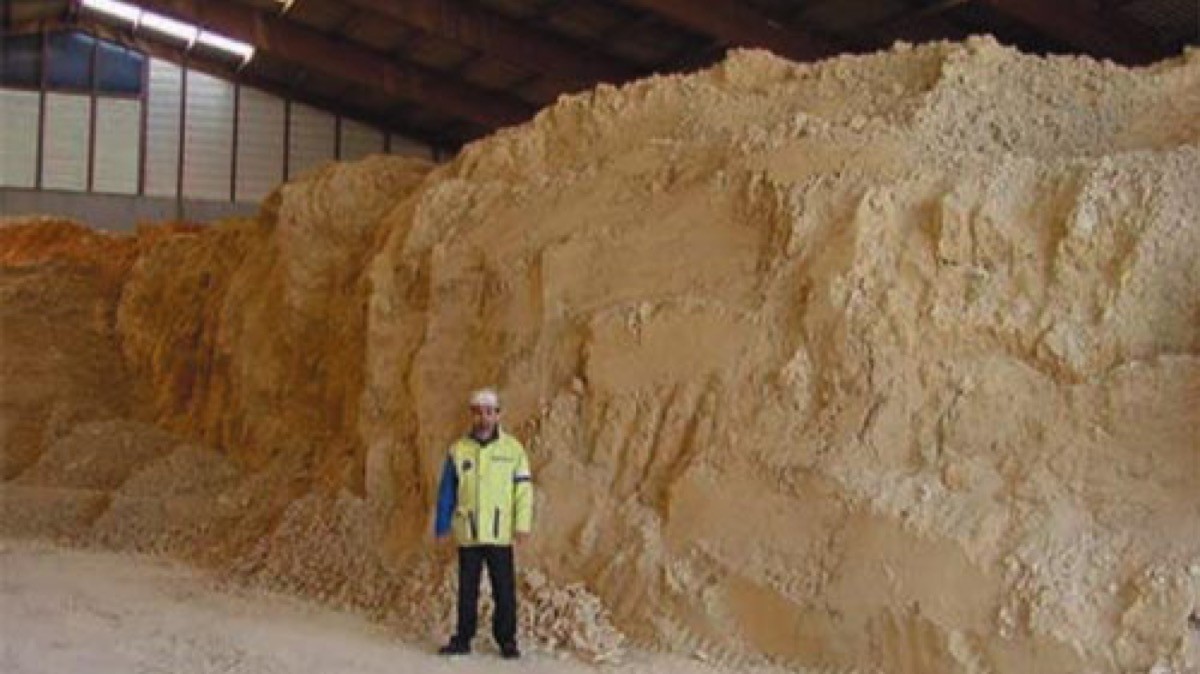
Radium-bearing waste at the La Rochelle plant.
Vie longue means it does not go away. The glossary sets a threshold at 31 years of half-life. Below it a waste is short-lived. Above it, long-lived. Thorium and radium are on the wrong side of the threshold.
Too long, too weak
“It is generally considered that waste with a low or medium initial activity and a short half-life loses its dangerous character after 300 years at most.”
A 300-year design is the lifespan of a surface disposal center. Assuming the physical structure lives after the material has lost its dangerous character.
Thorium does not expire in 300 years. Since the end of 2024 the 8,510 tonnes of it in France have decayed by about seven tenths of one gram. To lose a single tonne takes two and a half million years.
Turn your phone sideways to read the charts. They are best on a desktop.
Radioactive decay · day one to one billion years
At three hundred years the caesium is gone and the thorium has not moved
Every dot is an equal share of a pile: orange while it is still radioactive, blue once it has decayed into something stable. Drag the handle through time. The shaded stretch is the first three hundred years, the life a surface disposal centre is designed for.
caesium‑137 becomes barium‑137, stable
thorium‑232 becomes lead‑208, through ten short lived members
day one
Within the design life of a surface centre
- Still radioactive
- Caesium-137100.0%
- Thorium-232100.0%
Drag the handle→
Half lives: Laboratoire National Henri Becquerel, Table de Radionucléides.
Three hundred year design life of a surface centre: IAEA, NW-T-1.27, 2020, p.37.
+–Table view
| Time | Caesium-137 | Thorium-232 |
|---|---|---|
| Day one | 100.0% | 100.0% |
| 30 years | 50.0% | 100.0% |
| 300 years | 0.098% | 100.0% |
| 1 million years | 0% | 100.0% |
| 1 billion years | 0% | 95.2% |
So FA-VL is an awkward middle. Too long-lived for the cheap surface route. Not radioactive enough to justify the deep repository being built for the reactor waste.
Every other class of French radioactive waste that has somewhere to go shows a capacity in the hundreds of thousands or the millions. The one class that has nowhere shows a zero.
Category | Total | Entreposés | Stockés | Capacité des stockages existants |
|---|---|---|---|---|
FA-VL | 87 214 | 87 214 | 0 | 0 |
FMA-VC | 904 851 | 73 175 | 831 676 | 1 530 000 |
TFA | 463 775 | 160 847 | 302 928 | 650 000 |
So why not just sell the stuff and be done?
Liability
Because almost nobody wants it.
The uranium Rhône-Poulenc separated each year went to EDF[5] for its power stations.
The thorium had a market you could fit in a rucksack. In 1988 the plant director was asked what it was for. He said “There is 5 to 6 per cent thorium left, used mainly for camping gas lamps.”
The rest of the justification was the future. The thorium was, and still is, stored at the plant in the hope that it could one day fuel a new generation of cleaner nuclear power stations.
In the twenty years since, they have managed to sell about 60 tonnes, all of it between 2019 and 2021.
So the pile stays. Which brings us back to the thing the state promised in 2004.
The promise
A disposal site for this waste, in service around 2010.
It has now been restated 26 times and moved 14 times. In 2005 the date became 2012 to 2013. In 2009 it became 2019. After 2009 no edition of the national inventory gives an opening year at all.
And in 2005, the state defined the thing it was offering instead. Storage at the production sites is a temporary solution, it wrote, even if the duration can be several decades. So everything remains where they are for now.
Where does the waste go?
Nowhere
It does not go anywhere. That is the answer.
The two thorium piles never moved. They are in dedicated buildings at Chef de Baie, where they were made.
The rest is spread across four places under three owners. Only one of the four is in Rhodia's facility. The ordinary solid residue is in the port fill at La Pallice, on land belonging to the city of La Rochelle. The surplus of that fill was moved in 1995 to Anse Saint-Marc, now owned by the state roads authority. The radium-bearing residue is in 25,302 drums at the CEA site at Cadarache, in a zone the inventory still labels RHODIA.
The company keeps the plant, but the state does the storage. This is one of the reasons a separation plant in France is not attractive to the state.
A note on translation.
And none of it is disposed of. The French word is entreposage, which means temporary, pending recovery. Stockage means permanent. English merges the two into storage and loses the whole point. If you read only the English version, you won’t see the problem.
Why did France not build the permanent one?
Consent
In 2008 the state went looking for a site. Andra contacted 3,115 communes whose ground was geologically suitable. About forty said they were interested.
The government picked two in June 2009 for survey. Both withdrew under local pressure. Then the state replaced the facility with a report.
The popular belief is to blame China, Chernobyl and sometimes the technology of storage. In reality France couldn’t get the consent.
So France cannot build a repository?
It can
It is building one right now. Cigéo[7], the underground repository for waste from the reactors.
It opens in 2050. France told the European Commission 2035. In 2012 they promised the year 2025.
But Cigéo is for reactor waste, the most radioactive kind, and La Rochelle's residue is not allowed in it.
What that residue needs is a shallow site, somewhere between the surface and 200 meters down. France has surface centers for the weak material. It is digging the deep one for the strong material. It has never built the one in between.
Could the residue go abroad instead?
A one-way door
France forbids the disposal of foreign radioactive waste on its territory. Article L.542-2, from the law of 30 December 1991.
It bans disposal in France of waste from abroad. It says nothing about French waste going out.
So a shared European facility cannot be in France. The country with the largest rare earth separation plant in Europe and the largest thorium pile is the one country legally barred from hosting the solution. Everyone else who might host is being asked to take the residue of a French industry. That is a political question.
Meanwhile the prefect[6] orders Solvay to examine, every five years, which structures in France or abroad could take the material.
Could it just be weak enough not to count?
No exit at the bottom
Other countries set a clearance threshold. A number below which material stops being radioactive and goes into the ordinary waste system. France does not.
But that is not what traps the La Rochelle stocks.
France does set a classification line for naturally radioactive material. 1000 becquerels per kilo for the uranium and thorium chains.
The crude thorium hydroxide is 720 becquerels per gram. The thorium nitrate is 1,650.
Hundreds of times over. The low-activity exit was never available to this material. The only door that could take a pile of that activity was the one they used. Declare a use.
Is this only a French problem?
Europe
No.
No member state has told the Commission it has an agreement to use a disposal facility in another country. Not one.
And half of them are counting on a shared European facility. None of their programmes sets a single milestone towards building it.
So nobody can send it away, and half the continent is waiting for something nobody has started.
What happens when someone builds a new plant?
Lacq
France is building a second rare earth separation plant right now.
CAREMAG, at Mont, on the Induslacq platform. Building permit February 2023. Operating authorisation 27 September 2023. Construction started April 2025. Commissioning this year.
It will recycle magnets, which has no thorium. And it will separate heavy rare earths from mined concentrate, which does.The concentrate comes from Australia, the United States or Estonia.
The file declares what is in that concentrate. Heavy rare earth carbonates, mainly samarium, gadolinium and yttrium. Three hazard statements between them: irritates the skin, seriously irritates the eyes, may irritate the respiratory tract. That is the entire declared composition of ten thousand tonnes a year of mined ore concentrate.
And the file will not say what kind of material it is. In one place the feed is heavy rare earth carbonates, which is a processed intermediate. In another it is concentrates from mining projects, which is ore. Those are not the same thing. A mineral concentrate has thorium. A carbonate has usually had the thorium taken out already. The file uses both words for the same stream and never resolves it.
The environmental authority assessed soil, groundwater, water use, discharges, air, odours, noise, light, flooding, biodiversity, traffic, landscape, technological risk and health risk. It named the substances of concern down to benzene and ethylene oxide.
Radioactivity is not in it.
Thorium appears zero times. Uranium zero. Radium zero. Becquerel zero. The word radioactivity appears twice, and both times it is the same sentence in a table of advantages. Pas de radioactivite a traiter. No radioactivity to treat.
The application declares thirteen regulatory headings. None is in the 1700 series, the series that covers radioactive substances. The platform it sits on holds twenty-five headings. None is either.
Let’s be even more pedantic.
The plant takes in 12,000 tonnes a year of solid feedstock. It declares 2,760 tonnes a year of dangerous waste. All of it comes from the 2,000 tonnes of magnets. The 10,000 tonnes of mined concentrate is described as undergoing total dissolution and is accounted for with no residue at all.
The application lists two dangerous waste streams that come from the magnets. Nothing from the ten thousand tonnes of mined concentrate appears anywhere.
The environmental authority saw it. It wrote that the impact study seems to cover only the recycling half, and asked for that to be sorted out. The permit was signed four months later.
CAREMAG is a subsidiary of Carester, and one of the three services it advertises is eliminating radioactivity. So they are fully aware of the problem.
If there really is no radioactivity to treat, it is true for exactly the reason it is true at La Rochelle. Somebody else stripped it. The newest rare earth plant in Europe would then have solved the problem the way the oldest one did, by buying material another country has already cleaned, and the application proving it contains no measurement of what was cleaned out or where that went.
How does that happen?
Nobody's job
Inspectors go to La Rochelle every year. In September 2022 they went about carbon quotas. In September 2023 they wrote sixteen findings, on fire water pressure, a tank you cannot see the level in, a subcontractor who got on site without an induction. Nothing about thorium at all. They are checking whether the plant obeys its permit. Nobody checks the permit.
Andra writes the classification down and says that it has no power to check it. What it publishes is what the holder declared.
At Lacq you can watch the same thing happen three times.
The danger study asks three questions of every substance. Will it burn. Will it explode. Is it toxic. The mined concentrate answers no three times and the study stops there.
The soil report drops it without saying why.
The health assessment never picks it up at all. Everything it models comes from ten tonnes a year of plastic binder in recycled magnets.
And in the table that decides what to look for in the ground, the row for the building where the concentrate meets the acid is blank.
Every one of those is correct. The material went through a set of tests, none of which was built to find it, and came out marked not dangerous.
So what is the actual barrier?
The pile is the moat
Not the technology. Anyone can separate rare earths. The science is well-known.
Not the classification either. The sentence is available to everybody. It is not a threshold you get under, it is a declaration you write.
The moat is the permission to hold the material while you are not recovering it.
Rhodia's prefectural order authorises 45,365 tonnes of radioactive residue to stand on that site, itemised down to the oxalate. Granted long ago, renewed unchanged through three orders in ten years. Renewing a ceiling is a different political act from granting one.
A new entrant asks for the grant. Today. With a public inquiry attached. On ground that is not already contaminated, unlike Rhodia’s. In a country that asked 3,115 towns and ended with none.
The incumbent's advantage is a grandfathered right to hold something nobody will take. So, it used to be a liability which turned into an asset.
What should an investor ask?
Where does the thorium go
Ask it of any European separation plant. Where does the thorium go.
France's inventory says a temporary store, for thirty years and counting, with the permanent route still described as under study and one failed siting round behind it.
A project that cannot name the destination of its residue has an unpriced liability.
Europe can separate rare earths. On condition that it never touches the ore, and never has to answer where the residue goes.
Notes
[1] Andra, Agence nationale pour la gestion des déchets radioactifs. The state agency for radioactive waste. It operates France's disposal centres and publishes the national inventory. It records what holders declare and has no power to verify it [R4 p.9].
[2] CRIIRAD, Commission de recherche et d'information indépendantes sur la radioactivité. An independent laboratory founded in 1986, funded by subscription, set up to measure radioactivity outside the state system.
[3] The SCPRI, Service central de protection contre les rayonnements ionisants. The health ministry's radiation service, which held the monopoly on official measurement in France until the 1990s.
[4] The CEA, Commissariat à l'énergie atomique et aux énergies alternatives. The state atomic energy body. It runs the Cadarache site where the radium-bearing residue from La Rochelle is stored.
[5] EDF, Électricité de France. The state electricity utility that operates the country's reactors.
[6] The prefecture, the central state's representative in each department. A prefectural order is issued by the prefect on behalf of the state, not by the town or the region, which is why a local council can neither grant one nor take one away.
[7] Cigéo, Centre industriel de stockage géologique. The deep repository under construction in clay in eastern France for waste from the reactors.
References
Agence nationale pour la gestion des déchets radioactifs. (2004). Inventaire national des déchets radioactifs et des matières valorisables: Rapport de synthèse. Collection Les Rapports. [R4]
Agence nationale pour la gestion des déchets radioactifs. (2006). Inventaire national des déchets radioactifs et des matières valorisables: Catalogue descriptif des familles. Collection Les Références. [R5]
Agence nationale pour la gestion des déchets radioactifs. (2006). Inventaire géographique des déchets radioactifs: Où sont les déchets radioactifs? Collection Les Références. [R6]
Agence nationale pour la gestion des déchets radioactifs. (2006). Résumé de l'Inventaire national: Déchets radioactifs et matières valorisables. Collection Les Références. [R7]
Agence nationale pour la gestion des déchets radioactifs. (2009). Inventaire national des matières et déchets radioactifs: Inventaire géographique. [R11]
Agence nationale pour la gestion des déchets radioactifs. (2009). National inventory of radioactive materials and waste: In summary. [R12]
Agence nationale pour la gestion des déchets radioactifs. (2009). Inventaire national des matières et déchets radioactifs: Rapport de synthèse. [R14]
Agence nationale pour la gestion des déchets radioactifs. (2012). Inventaire national des matières et déchets radioactifs: Inventaire géographique. [R17]
Agence nationale pour la gestion des déchets radioactifs. (2015). Inventaire national des matières et déchets radioactifs: Rapport de synthèse. [R36]
Agence nationale pour la gestion des déchets radioactifs. (2015). Inventaire national des matières et déchets radioactifs: Inventaire géographique. [R35]
Agence nationale pour la gestion des déchets radioactifs. (2016). Inventaire national des matières et déchets radioactifs: Bilan à fin 2015. [R31]
Agence nationale pour la gestion des déchets radioactifs. (2020). Inventaire national des matières et déchets radioactifs: Les essentiels 2020. [R69]
Agence nationale pour la gestion des déchets radioactifs. (2020). Inventaire national des matières et déchets radioactifs: Déchets déclarés au 31 décembre 2019 [Data set]. [R66]
Agence nationale pour la gestion des déchets radioactifs. (2021). Inventaire national des matières et déchets radioactifs: Déchets déclarés à fin 2020 [Data set]. [R73]
Agence nationale pour la gestion des déchets radioactifs. (2022). Inventaire national des matières et déchets radioactifs: Les essentiels 2022. [R101]
Agence nationale pour la gestion des déchets radioactifs. (2022). Inventaire national des matières et déchets radioactifs: Déchets déclarés à fin 2021 [Data set]. [R97]
Agence nationale pour la gestion des déchets radioactifs. (2023). Inventaire national des matières et déchets radioactifs: Les essentiels 2023. [R98]
Agence nationale pour la gestion des déchets radioactifs. (2024). Inventaire national des matières et déchets radioactifs: Catalogue descriptif des matières 2024. [R143]
European Commission. (2017). Report from the Commission to the Council and the European Parliament on progress of implementation (COM(2017) 236 final). [R47]
International Atomic Energy Agency. (2014). Near surface disposal facilities for radioactive waste (IAEA Safety Standards Series No. SSG-29). IAEA. https://www-pub.iaea.org/MTCD/Publications/PDF/Pub1637_web.pdf
International Atomic Energy Agency. (2020). Design principles and approaches for radioactive waste repositories (IAEA Nuclear Energy Series No. NW-T-1.27). IAEA.
Laboratoire National Henri Becquerel. (2012). Table de radionucléides: Th-232. LNE-LNHB/CEA. http://www.lnhb.fr/nuclides/Th-232_tables.pdf
Laboratoire National Henri Becquerel. (2005). Table de radionucléides: Sr-90. LNE-LNHB/CEA. http://www.lnhb.fr/nuclides/Sr-90_tables.pdf
Laboratoire National Henri Becquerel. (2023). Table de radionucléides: Cs-137. LNE-LNHB/CEA. http://www.lnhb.fr/nuclides/Cs-137_tables.pdf
Mission régionale d'autorité environnementale Nouvelle-Aquitaine. (2022, March 15). Avis sur le projet de recyclage de terres rares, site de Lacq, commune de Mont (64), société CAREMAG. [R110]
Préfecture de la Charente-Maritime. (2022, August 12). Arrêté préfectoral, Rhodia Opérations, La Rochelle. [R113]
Préfecture de la Charente-Maritime. (2022, September 21). Rapport d'inspection, Rhodia Opérations, La Rochelle. [R118]
Préfecture de la Charente-Maritime. (2023, June 29). Arrêté préfectoral, Rhodia Opérations, La Rochelle. [R136]
Préfecture de la Charente-Maritime. (2023, September 27). Rapport d'inspection, Rhodia Opérations, La Rochelle. [R137]
Préfecture de la Charente-Maritime. (2026, July 6). Arrêté préfectoral modifiant les prescriptions, société Rhodia, La Rochelle. [R186]
Published by House of Hōma OÜ, registered in Estonia.