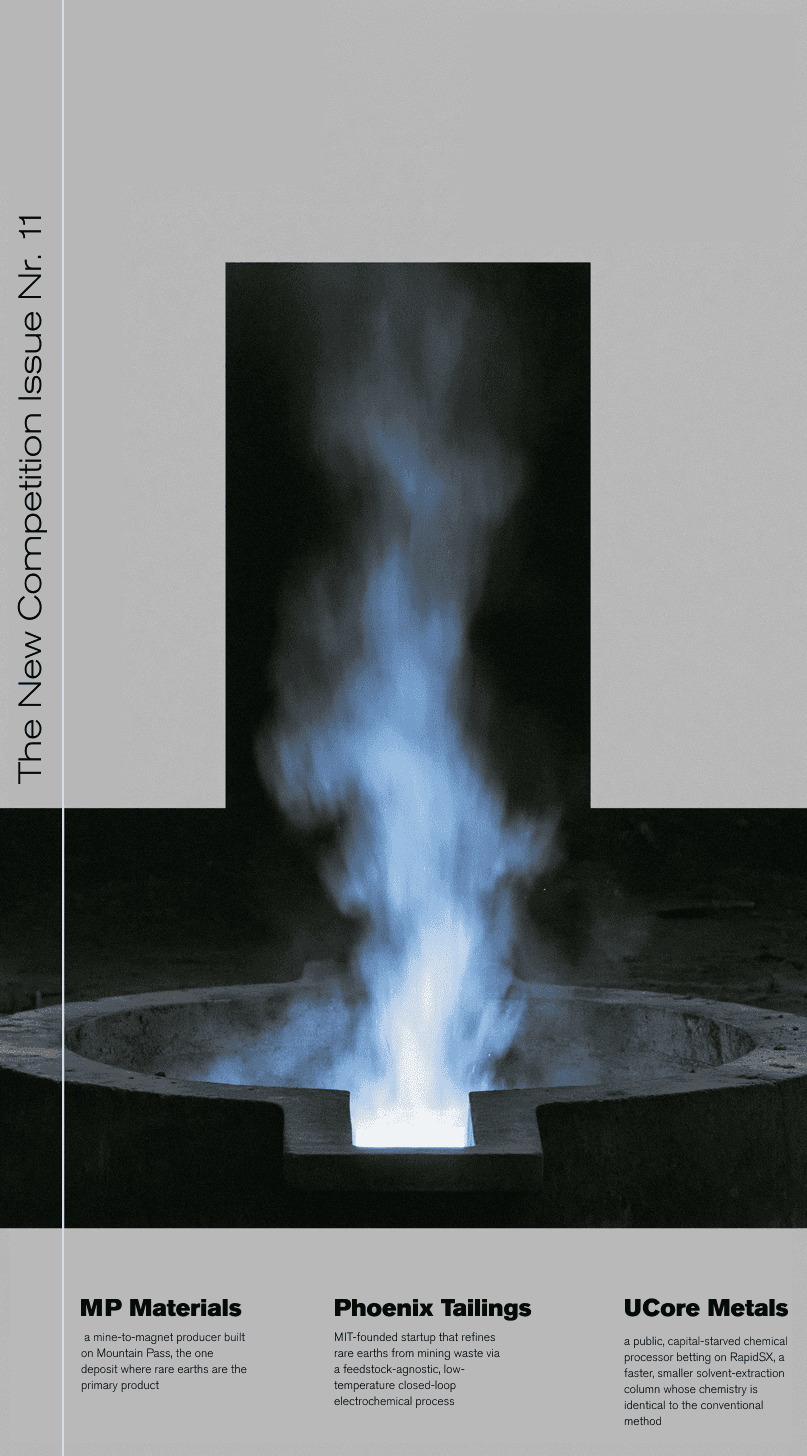

So they decided to go shopping separately into the deep north, probably the most sophisticated shopping of the century so far
We care about what happened after May 2023. The founders of three companies realized that people care so much about what computation can do, and less about the outcome right away. But they knew that the gold rush would not last, so they decided to go shopping separately into the deep north, probably the most sophisticated shopping of the century so far.
But what happened before May 2023?
In 2013, a company in Alberta started to fit itself into the oil giants. Enersoft was born, and so was the race to vertical integration. But they needed capital, and a lot of it.
The investment thesis
Silicon Valley didn’t have the model to invest in exploration tech in 2013. The Venture capital firms were much more scattered. The deep-tech startups either raised on grants, angels, incubators, or proved their competence to the incumbents. Enersoft chose the first and the last.
When oil was worth $114, who was thinking about lithium?
in periods when the price of oil is high, it is natural to think of extracting oil from unconventional reservoirs. Between 2011 and 2013, the peak was almost ¢114 a barrel. The time Enersoft was born was the moment for unconventional reservoir discovery. Extraction needed unconventional equipment and software. Oil giants financed the R&D, and Enersoft could co-develop software and hardware with the oil companies.
Grant Sanden, co-founder and CEO of Enersoft Inc. in an interview:
For modern unconventional resource plays, the scale of geological importance has moved to the sub-cm level which cannot be effectively analyzed using conventional physical and chemical lab tests. We’re using robotized machine vision as a key component for the high resolution analysis of rocks in mining and oil and gas.
One of the key innovations is we’ve collocated a ton of different instruments to look at reservoir complexity. We have x-rays to analyze elements, spectroscopy to analyze bonds, high-resolution cameras and confocal lasers to look at the particles, their shape, their size and their sorting. Once you take all those meaningful degrees of freedom and put them together at high resolution, you can do very advanced analytics on the reservoir.
People always tell you who they are. Grant Sanden told us in 2018.
We have to pay attention to two things here:
First, they were applying new technology to an old industry. The very same reason Blackbird Venture invested in Earth AI, interesting enough in 2018, the same year Grant Sanden had the interviews.
Second, is the last sentence in Sanden’s words, the stack of technologies is their competitive advantage, and since 2018, they have improved it. This matters later in 2025 when they acquired the last piece of the available technology that makes their moat wider than any competitor. The pattern is in their DNA they acquire or build.
But then came the crash. (2014 -2020)
Low prices of oil force companies to develop new technologies. This time for efficiency. This means increasing the speed and reliability of equipment, increased automation, because automation reduces a dependency on personnel.
In the same interview, Sanden says:
One of the keys is we’re fast to fail so we try things out. We have the equipment to manufacture our own parts to robotize all sorts of instruments, so we can try them out quickly and cheaply and see what works. When you do this you can quickly build knowledge until you have quite a suite of products that solve market problems. Then you jump on the ones that have the most traction.
Rapid prototyping on what works and a fast negative feedback loop created a plethora of tools no one else had. The Same scheme Kelly Johnson used to build the SR-71 Blackbird.
This company was from the very beginning tech-forward, the timing allowed them to co-develop with their clients, and then once again the timing (oil price crash) made them indispensable to the same clients.
Their competitive advantage became multilayer, working with their clients, and their fast prototyping model. The rapid equipment design, combined with rapid implementation, gave them an escape velocity that the competitors didn’t have.
They had a fund-earning plan
Enersoft received four contributions between 2013 and 2021. Pitchbook logged these as grants, but grants and contributions are not the same.
contributions are paid on a reimbursement basis. In our language, contributions are paid in tranches, not upfront.
Enersoft was operating in a reimbursement model from 2013 to 2021. That means for eight years, before a single dollar of private capital arrived, the founders were personally carrying the cost of building the technology. Submitted claims, waiting for reimbursement, and proving progress to government auditors at each stage.
That is the opposite of a startup that raised a seed round and ran on investor cash. That is a company that bootstrapped itself through a performance-gated government reimbursement system across three oil price crashes of 2014, 2016, and 2018, while simultaneously embedding itself inside university research institutions and oil sands majors.
The due diligence private investors didn’t have to do
How they received the fund (contribution type) and when they received it (during crashes) signals private investors in 2023 the business acumen of founders, and performance of the company even when things don’t go right.
Their competitive advantage needed a leap in 2019
By 2019, Enersoft had developed a plethora of tools and software. A list of technology stacks is not interesting until you realize they were developing these tools while bootstrapping themselves, and there is one more reason to go through their technology stack: it’s essential to understand the technology to understand the competition with Veracio and IMDEX in 2025 and beyond.
I skip the engineering details of their technology now, but in plain English, here is what they had built in 2019.
Think of it like a sommelier reading a wine without opening the bottle.
A traditional geologist looking at a core sample is like a wine buyer. What Enersoft built was the instrument stack that makes the bottle transparent.
The high-resolution camera reads the label in extraordinary detail, every grain, layer, and surface marking that tells a story about where this rock has been. The X-ray fluorescence (XFR) is the chemical analyser that tells you exactly what grape varieties are in the blend, iron, copper and .. without uncorking a single bottle. The infrared spectroscopy is the instrument that reads the tannins and the acidity in cores, it mean the molecular architecture underneath the surface chemistry, the bonds that tell you not just what is there but how it got there. The 3D profiling laser is the scale that measures the weight, the density, the physical geometry of every centimetre, the things that tell an expert how the bottle was made before they ever taste it. And hyperspectral imaging is the light table, the device that reveals what is happening inside the glass itself, the colour gradients and mineral hazes invisible to any other instrument.
The automated scanning table is the cellar conveyor that moves a thousand bottles past all five instruments in the time it used to take to examine one. The machine vision is the master sommelier who reads all five outputs simultaneously and produces a verdict in seconds. The software turns that verdict into a cellar plan, a purchase order, a mine plan.
Canada saw it before Bill Gates did
By 2019/2020, Northern Alberta Institute of Technology (NAIT) independently used Enersoft's hyperspectral and XRF prediction model across 30 oil sands core wells at Imperial Oil's Kearl mine. And the IOSI 2020-21 report explicitly states that the concept of using hyperspectral imaging to characterize oil sands was first developed at the University of Alberta and later commercialized by Enersoft Inc. That single line is the most authoritative independent confirmation of their IP origin. That’s where the lawyers entered in 2025, but more on that later.
It establishes that Enersoft's commercial technology had its scientific roots inside the University of Alberta, not in a garage. The company did not invent something and then sought academic validation. Enersoft was the commercial arm that brought it to market.
The caterpillar had a name. On May 26, 2020, so did the butterfly
Enersoft became the legal shell of something the world would come to know as GeologicAI. This is the earliest confirmed date they committed to the new name.
The largest single government contribution Enersoft ever received was $1,375,000 from Western Economic Diversification Canada, awarded December 16, 2020, with the explicit purpose: "Expand geological core scanning technology to increase market reach in the mining sector.
They had four out of 5 sensors by that time, these years are the cornerstone of why investors in 2023 and 2025 invested in GeologicAI
In March 2021, Enersoft was named as an industry partner on a $928,000 Alberta Innovates LIBS (Laser-Induced Breakdown Spectroscopy) research project led by the University of Alberta, running through December 2023. The project aimed to develop a portable LIBS device for real-time elemental analysis of soil, with AI-based calibration algorithms, and targeted a jump from Technology Readiness Level 2 to 6. Enersoft's co-partners were the University of Regina, CropPro Consulting, and Boreal Laser. The project was structured to produce 6 publications, 2 patents, and 1 new commercial product or service. The ownership of the 2 patents projected from this project remains an open question worth investigating.
On LIBS as a defense and space technology
LIBS is not a mining technology, but happened to work in space. NASA has operated LIBS instruments on Mars since 2012, with the Curiosity rover alone generating hundreds of thousands of spectra on Martian rocks. The serious LIBS expertise has always lived in government labs, defense contractors, and specialist physics departments. None of GeologicAI's competitors appear to have recruited from those talent pools. GeologicAI's Senior VP of Engineering is a 25-year LIBS pioneer. That combination of deep domain expertise inaccessible to competitors, validated by space-grade technology, and protected by IP counsel retained at the Series B, describes a moat that is very difficult to replicate quickly.
But could anyone foresee it?
For evidence strictly before May 2020, the honest answer is that the 2014 patent covering mineral deposits proves the sector's ambition, but explicit AI language in public documents appears only at the moment of the rebrand itself.
The Moat and The Competitors
In 2023, the British Geological Survey described why multi-sensor integration is the future standard for core scanning. The BGS is one of the oldest and most authoritative geological institutions in the world. Its conclusion was that combining multiple scanning techniques within a single workflow produces a categorically more powerful discovery tool than any single sensor alone. GeologicAI had already been selling exactly that architecture for two years before the paper was published.
The BGS paper also confirmed the data moat that makes GeologicAI structurally difficult to displace. Core scanning data generates terabytes per project, can be stored indefinitely, and the accumulation of consistent high-resolution data over time is what enables machine learning models to improve. GeologicAI had scanned later over two million metres of core globally. That dataset took a decade to build and cannot be replicated by any new entrant regardless of how much capital they raise.
Finally the paper surveyed the global core scanning ecosystem and identified four categories of operators: national geological surveys, academic repositories, commercial labs, and mining-industry providers. GeologicAI competes in the fourth category but operates with the scientific rigor and data philosophy of the first. No named competitor does.
2023 - The Arms Race
Core scanning is not the only method, of course what competitors of GeologicAI are doing then ?
British Geological Survey and a geotechnical engineering study on acoustic televiewer imaging confirms that core scanning and borehole logging are complementary technologies, not alternatives.
Borehole logging captures structural data from the borehole wall while still underground but without access to the physical rock its confidence is demonstrably lower. The hybrid study found that televiewer logging done without physical core access produced 185 erroneous structural data points. The BGS paper confirms that core scan data must be depth-matched to wireline logs to achieve volumetric parameterization, it means the core is the anchor, and borehole data is the extension. GeologicAI sits at the most defensible position in this chain: the physical rock itself, scanned with five integrated sensors, now including LIBS. No competitor has replicated that stack.
Breakthrough Energy Venture .
Everything they had done prior to 2023 de-risked the investment of BEV into GeologicAI. At that time, the investment was self-evident; the macro factors like electrification and the BEV investment thesis in frontier deep-tech made GeologicAI an obvious choice. And then the race started .
Veracio had just been spun out of Boart Longyear, which finally decided its data division was worth more as a standalone. In September 2023, Veracio acquired Minalyze, the Swedish XRF core scanning company, for $29.3 million. The logic was: they had the AI software and the downhole tools, Minalyze had the physical scanners and the client base. Put them together, and you have something that looks like a platform.
IMDEX, another competitor, did not buy a scanner. In 2023, the Australian company spent over $300 million acquiring Devico, the Norwegian directional drilling pioneer. Then it acquired Krux Analytics to digitize its real-time drilling optimization business.
GeologicAI watched all of this and did two things. In February 2024, it acquired Resource Modeling Solutions in Calgary, the piece that converts a line of scan data into a three-dimensional block model a mine planner can act on. Then in December 2025, it acquired Lumo Analytics in Finland, the tech that detects rare earth elements and lithium that no XRF scanner on the market could see. Two acquisitions, one closes the software loop, the other closes the hardware loop. The stack was complete.
Veracio assembled in two years what GeologicAI had built organically in ten years, but much slower and much different, since they do borehole scanning as well.
No One Can Copy Them
Blue Earth Capital invested $44 million in GeologicAI in 2025.
Why they decided to invest in GeologicAI is more important than 44 million. They never publicly announced why, but we can guess by looking at who advised them to invest.
Gibson Dunn is a special law firm. You hire them to make the deal as waterproof as a Rolex case. They had dedicated two IP associates to the deal. You do not bring that level of counsel into a mining software transaction unless the intellectual property is both proprietary and central to the valuation.
GeologicAI's sensor stack combines hyperspectral imaging, XRF, RGB, LiDAR, and LIBS. Every competitor picks one or two. XRF dominates the market, hyperspectral is the second most common approach, but neither can detect light elements like lithium, which is precisely what the critical minerals race demands. The Lumo acquisition, executed months after the Series B closed (Blue Earth Capital), was the final piece of a stack that had been deliberately engineered over a decade. The Gibson Dunn engagement was Blue Earth Capital verifying that what GeologicAI built could not be replicated by a well-funded competitor.
The Mining Singularity
The arms race has just begun. Whether GeologicAI moves into borehole scanning territory is not speculation. They have a track record of stacking technologies and unifying data into software platforms. They have acquired two companies. Development of new technologies takes decades, and private capital will be abundant to spend on acquisitions.
In August 2024, eight months after the Lumo acquisition completed the sensor stack and weeks after Blue Earth Capital closed the Series B, Enersoft Inc. filed a trademark. Not for GeologicAI but for something called The Mining Singularity. The application was approved nine days ago.
The goods and services listed in that filing cover mining, oil and gas, construction, and engineering projects. A company that spent a decade building the most complete geological data platform in the world does not file a trademark for The Mining Singularity to sell more core scanners. The arms race has just begun.
References
Company and regulatory records
PitchBook. (n.d.). Enersoft Inc. company profile. https://pitchbook.com/profiles/company/84718-81
ASTech Foundation. (2018). Index of past winners: Enersoft Inc. https://astech.ca/archives/indexofpastwinners/enersoft-inc
Government of Canada. (2013–2020). Grants and contributions: Enersoft Inc. Open Government Portal. https://search.open.canada.ca/grants/?sort=score+desc&page=1&search_text=Enersoft
Government of Canada. (n.d.). Grants and contributions process: Difference between grants and contributions. Employment and Social Development Canada. https://www.canada.ca/en/employment-social-development/services/funding/grants-contributions-process.html
Canadian Securities Administrators. (2023–2025). Form 45-106F1 reports of exempt distribution: Enersoft Inc. (SEDAR+ profile 000052885). SEDAR+. https://www.sedarplus.ca
Canadian Intellectual Property Office. (2020). Trademark application 2030396: ENERSOFT [Filed May 26, 2020]. Innovation, Science and Economic Development Canada. https://ised-isde.canada.ca/cipo/trademark-search/1625247
Canadian Intellectual Property Office. (2022). Trademark application 2186268: GEOLOGICAI & Design [Filed May 18, 2022; Registered April 23, 2025]. Innovation, Science and Economic Development Canada. https://ised-isde.canada.ca/cipo/trademark-search/pdf/2186268?lang=eng
United States Patent and Trademark Office. (2020). Trademark application serial number 90323541: GEOLOGICAI [Filed November 17, 2020]. USPTO Trademark Status and Document Retrieval. https://tsdr.uspto.gov/#caseNumber=90323541&caseSearchType=US_APPLICATION&caseType=DEFAULT&searchType=statusSearch
Canadian Intellectual Property Office. (2024). Trademark application 2345881: THE MINING SINGULARITY [Filed August 26, 2024; Approved May 21, 2026]. Innovation, Science and Economic Development Canada. https://ised-isde.canada.ca/cipo/trademark-search/2345881?wbdisable=true
Press and media
Calgary Herald. (n.d.). Startup of the week: Enersoft. https://calgaryherald.com/business/local-business/startup-of-the-week-enersoft
Canadian Mining Journal. (n.d.). AI-driven core scanning aims to speed exploration decisions. https://www.canadianminingjournal.com/featured-article/ai-driven-core-scanning-aims-to-speed-exploration-decisions/
Betakit. (2025, December). GeologicAI acquires Finland's Lumo Analytics to round out suite of critical minerals sensors. https://betakit.com/geologicai-acquires-finlands-lumo-analytics-to-round-out-suite-of-critical-minerals-sensors/
GeologicAI. (2024, February). GeologicAI acquires Resource Modeling Solutions. https://www.geologicai.com/blog/geologicai-acquires-resource-modeling-solutions/
Gibson, Dunn & Crutcher LLP. (2025). Gibson Dunn advised Blue Earth Capital on Series B funding round for GeologicAI. https://www.gibsondunn.com/gibson-dunn-advised-blue-earth-capital-on-series-b-funding-round-for-geologicai/
GeologicAI. (2023, June 29). Investment in the future [Series A press release]. https://www.geologicai.com/blog/investment-in-the-future/
Academic and institutional
Damaschke, M., Monaghan, A., Kearsey, T., Campbell, S., & Fellgett, M. (2023). Unlocking national treasures: The core scanning approach. Geological Society of London Special Publications, 527, 75–93. https://doi.org/10.1144/SP527-2022-116
Institute for Oil Sands Innovation. (2020). Annual report 2019–2020. University of Alberta.
Institute for Oil Sands Innovation. (2021). Annual report 2020–2021. University of Alberta.
Alberta Innovates. (2021, November). Project summary: Laser-induced breakdown spectroscopy for in-situ soil analysis. https://albertainnovates.ca/wp-content/uploads/2021/11/AI-CR-Project-Summary-Laser-Induced-Breakdown-Spectroscopy-for-In-situ-Soil-Analysis.pdf
Sjöqvist, A. S. L., Arthursson, M., Lundström, A., Calderón Estrada, E., Inerfeldt, A., & Lorenz, H. (2015). An innovative optical and chemical drill core scanner. Scientific Drilling, 19, 13–16. https://doi.org/10.5194/sd-19-13-2015
Reference and context
Investopedia. (n.d.). Unconventional oil. https://www.investopedia.com/terms/u/uncoventional-oil.asp
Macrotrends. (n.d.). Crude oil price history chart. https://www.macrotrends.net/1369/crude-oil-price-history-chart
Turn your phone sideways to read the charts. They are best on a desktop.
Published by House of Hōma OÜ, registered in Estonia.