

Mine to magnet? This is what the complexity looks like.
One magnet
The President of the European Commission showed the G7 leaders in June 2025 a magnet. She said: "It was manufactured in Estonia, by a Canadian company using raw materials sourced from Australia, and supported by the EU's Just Transition Fund"
The Canadian company is Neo Performance Materials. In Estonia it runs a separation plant at Sillamäe and a magnet plant in Narva.
The chain on paper
Neo presents the whole chain as done: "Separation, Metal Making, Magnet Making & Recycling are vertically Integrated in Estonia." Where is the mine?
The feed
Neo has no mine. The Sillamäe separation plant buys its feed.
Why there is no mine? Maybe that was the part of the plan to differentiate
As they said in 2017, Neo engineers proprietary products, for its customers’ unique applications. It focuses on highly engineered functional REE and rare metal materials. It differentiates itself from domestic Chinese processors, who focus primarily on separation, a relatively commoditized process. Neo as the only non-Chinese operator permitted to separate REEs in China provides sustainable competitive advantages over other international producers. While their customers benefitting from local sourcing and production, allows Neo to offer its products to its customers at competitive prices.
It was not always like this. Before Neo, the plant had struggled with its feed for 17 years, and two of its owners came with a mine behind them.
Before the mines: 2003
In 2003 the plant was owned by AS Silmet Grupp, an Estonian holding company, and Treibacher Industrie AG. That summer the plant stopped its rare earth factory for three months, "owing to the general low state of the markets and the irregular deliveries of raw material." To keep running, it replaced the rare earth chloride solutions it had been processing with lanthanum concentrate from the United States, under a three-year agreement. Two years later a new owner took over.
The first mine: Zimal, 2005 to 2010
At the end of 2005 a Swiss company, Zimal, bought 50 per cent plus one share. Its group indirectly held the Karnasurt loparite mine in Russia, the Solikamsk plant that processed the ore, and now Silmet. The plant wrote that belonging to this group "guarantees" its raw material. In 2007 it called itself "the only reliable rare earth producer that does not depend on the People's Republic of China or on raw material supplied from there".
Yet the same source blamed that year's loss mainly on raw material supply, without naming a supplier. Later, in 2009 the supply contracts were postponed over "the unfavorable price", until a compromise was reached and the rare earth factory's output could go on sale. And in 2010 Solikamsk[1] made less carbonate because its subsidiary LGOK had cut loparite output, and deliveries to Silmet got much worse. By the end of 2010 the next owner was already a customer of the plant.
The second mine: Molycorp, 2011 to 2015
In late 2010 Molycorp signed a contract to process its feed at the plant. In April 2011 it bought the plant. Molycorp had a mine Mountain Pass in California and began sending feed from there straight away. The Russian feed kept coming and kept being a problem: in 2011 supply from Solikamsk was "still problematic," partly because of the mine's low productivity. In 2012 the plant ran on both sources.
In the first half of 2015 the plant ran its rare earth factory at full capacity, "mainly thanks to raw material that came from Molycorp's plant at Mountain Pass." In the third quarter Mountain Pass was closed, and deliveries from it "stopped completely". In 2016 Molycorp went through bankruptcy. The company that had the mine went under, and the rest of the group moved on under a new name: Neo Performance Materials.
Neo and the Russian supplier
Neo described the Russian feed as a strength:
"a strategic non-Chinese source of supply from Russia, which is processed at Neo's facility in Estonia."
In the same prospectus it listed the same supply as a sanctions risk. Both were true at once. This is a complexity beyond the control of a single company, or even a handful of them, and no answer to it is permanent. The words around the supply changed with the politics.
Silmet, Sillamäe · the Russian feed, 1998 to 2025
The words around the supply changed with the politics
The document prints the name SolikamskIt does not name the supplier
Click on each dot to see more.
2024
November 2024
The lender's ban
“to make purchases or otherwise procure from State Atomic Energy Corporation Rosatom, Solikamsk Magnesium Works or any of their respective Subsidiaries.”
“Neo's Silmet facility sources the majority of its rare earth feedstock from a Russian supplier.”
Export Development Canada and Neo Performance Materials, loan agreement, 1 November 2024, p. 34. Neo Performance Materials, report for the third quarter of 2024, 13 November 2024, p. 11.
Quotes are exact. The Estonian passages are from the plant's own annual reports and are given in translation, with the original beneath. No document names Neo's Russian supplier. The 2024 loan agreement names Solikamsk Magnesium Works among those the loan may not be used to buy from; it does not say who the supplier is.
Table view
| Date | What the document says | Names Solikamsk | Source |
|---|---|---|---|
| October 1998 | Feed from Solikamsk, plant at 20% | Yes | NATO Advanced Research Workshop, Tallinn, 5 to 9 October 1998. Proceedings, 1999, pp. 43 and 74. |
| End of 2005 | Mine, processor and plant in one group | Yes | AS Silmet, annual report 2005, p. 5. |
| 2010 | The mine cuts output | Yes | AS Molycorp Silmet, annual report 2010, p. 3. |
| 2011 and 2012 | Still problematic | Yes | Molycorp Silmet AS, annual reports 2011 and 2012, p. 3 of each. |
| 30 November 2017 | Sold as a strength | No | Neo Performance Materials, listing prospectus, 30 November 2017, pp. 26 and 182. |
| 7 July 2021 | Long-time supplier | No | Neo Performance Materials and Energy Fuels, news release, 7 July 2021, p. 3. |
| 9 March 2022 | The majority | No | Neo Performance Materials, annual report for 2021, 9 March 2022, pp. 12 and 47. |
| 29 March 2023 | No replacement | No | Neo Performance Materials, Annual Information Form for 2022, 29 March 2023, p. 14. |
| November 2024 | The lender's ban | Yes | Export Development Canada and Neo Performance Materials, loan agreement, 1 November 2024, p. 34. Neo Performance Materials, report for the third quarter of 2024, 13 November 2024, p. 11. |
| 18 March 2025 | Still the majority | No | Neo Performance Materials, Annual Information Form for 2024, 18 March 2025, p. 13. |
In March 2023 Neo said: "at present production levels, alternative sources would not be sufficient to replace the existing Russian feedstock."
But they had already been looking for the feedstock somewhere else.
The search for other feed
The alternatives came and went. American carbonate from Energy Fuels delivered in 2021, and after eight containers Neo said the project "has not produced material outcomes as yet".
In 2023 Neo paid 3.5 million dollars for an exploration licence in Greenland and gave Sillamäe the right to buy up to 60 per cent of its ore. Brazil and South Africa came as memorandums, not contracts.
Finding feed is only half of it. Finding a non-radioactive feedstock is another half.
The radioactivity
In 2021 Neo's then chief executive said monazite feed had historically not been favored due to the naturally occurring radioactive elements they normally contain. Energy Fuels provides the missing link in solving this challenge. I've written at length about the radioactive problem in two earlier articles, Death by Nomenclature and The Thorium Test: Atlantic to Baltic.
The problem is old. In 1998 a NATO workshop looked at recovering metals from Sillamäe's old uranium tailings. It was told that thorium, uranium and arsenic "could devalue any concentrate produced", and that a refiner would likely charge a penalty for them. Silmet's staff called the plant "fairly high cost", and its rare earth markets were weak, given the extreme competitiveness of the Chinese producers.
Secure feed is hard to find. It also has to come with its radioactive elements taken out. Is the separation business worth it?
The economics of separation
In 2017 Neo called separation "a relatively commoditized process". A separation plant buys a mixed concentrate, splits it into single rare earths and sells them as oxides. "From Neo’s ZAMR and Silmet production facilities in Zibo, China and Sillamäe, Estonia, Neo processes LREC[2] into products such as cerium, lanthanum, neodymium and praseodymium oxides and salts." The plant earns the difference between what the feedstock costs and what the oxides sell for. Both prices move with the market.
The market moves a lot. The market price of neodymium outside China, in the first quarter of each year:
Neodymium outside China · dollars a kilogram
The market price outside China in the first quarter of each year, and at the end of March 2023.
Table view
| When | Dollars a kilogram |
|---|---|
| 2020 | about 42 |
| 2021 | 93 |
| 2022 | 174 |
| 2023 | 105 |
| End of March 2023 | closer to 80 |
In the rising years it made money. In 2021 higher prices supported higher dollar value margins in the rare earth separation business, and in 2022 again. Neo later called them the years of high profits.
Then the price fell. In the first quarter of 2023 the chemicals and oxides segment lost 6.1 million dollars after a net $6.4 million of provisions for inventories, while processing higher cost inventory . It is the same pattern as 2012 in the plant's Estonian reports. Separation ran at negative margins and closed 2023 with a negative gross margin. The Zibo plant in China lost money at the gross level in 2022 and 2023. In the first half of 2024 separation lost 2.6 million dollars at the gross level, before overheads, interest and tax.
In 2024 Neo agreed to sell its separation plants in China. The reason: "rare earth separation is the process step with highest exposure to underlying rare earth price volatility." It kept the one in Estonia. Separation as a whole, China included, made a gross margin of negative 1.6 million dollars in 2024.
But why did Neo stay in the separation business?
The investor deck of September 2025 said:
"Strategic asset operating at a loss today with valuable capabilities and a $50M+ replacement cost"
The chief executive in 2026 said: "It doesn't perform in terms of EBITDA just because volumes of feedstock are low and prices have been low."
So why keep it? Neo has given a reason each time, and the reason has changed. Because the world around it changed.
Useful
In 2017 the answer was the rest of the business. Separation was a small part of Neo, but it fed the parts that paid: it supplied the rare earths for Neo's magnet and catalyst powders, and its know-how had led Neo into car catalysts and later into wastewater treatment. Rare earths that outside customers did not take could go to Magnequench, Neo's magnet powder business. And customers valued supply "from both inside and outside of China". In 2023 it became part of a "Magnets-to-Mine" vertical integration strategy. In 2024 Neo said Magnequench takes 5 to 15 per cent of its magnetic oxides from Silmet.
Scarce
In 2025 the answer was scarcity. Neo called Silmet "a strategic asset providing capacity and capability that is generally considered scarce outside of China". Neo began designing a pilot line at Silmet "to produce dysprosium and terbium, supplying the newly constructed European PM facility", its magnet plant in Narva. The same deck that admitted the loss said: "As new feedstock sources become available, Silmet SX[3] is positioned to unlock meaningful value."
Waiting
And finally in 2026 it is waiting for better feed. It is "a highly strategic, non-captive asset, supported by a world-class laboratory", whose feed "limits near-term financial contribution, creating an opportunity for improved utilization and margin".
In August 2026 Neo agreed to process Carester's mixed rare earth carbonate at Sillamäe, keeping the light rare earths and returning the heavy ones to Carester. More on this cooperation later.
From oxide to magnet
In 2017 Sillamäe's neodymium oxide went to Thailand. A company there, partly owned by Neo (20%), turned it into metal for a fee. Neo's plant in Korat then made it into magnet powder.
Neo built its magnet plant at Narva, next to Sillamäe. In March 2026 the annual report listed among its milestones the "one-millionth magnet in February 2026", made as qualification samples. By September the plant was shipping magnets to a maker of electric car motors.
Sillamäe was one reason to build at Narva. Magnequench, Neo's magnet powder business, takes 5 to 15 per cent of its oxides from Sillamäe. In March 2025 the CEO said the next phase "is likely to stay in Estonia". Six months later Neo told investors it would "consider other jurisdictions such as North America, Vietnam" and Thailand.
Recycling
About 30 per cent of each alloy block is lost in cutting and grinding. A third of that, the cut pieces, goes back into the furnace at Narva. The rest, a sludge of alloy, abrasive and cutting fluid, was to go to "NPM Silmet or another company". Under an August 2026 agreement it will go to Carester in France, which will return the recovered oxides.
The patent wars
Rhodia, part of Solvay, sued Neo over rare earth mixed oxides for car exhaust catalysts, and by 2020 Neo was defending "in Germany, the United Kingdom, the People's Republic of China and Estonia". Neo said that if a court stopped a product in one country, it "could, in such event, re-establish its manufacturing capability for such products in jurisdictions not prohibited by any such orders". After losing in the UK, it said it would "continue to sell its products into patent-free jurisdictions".
In October 2020 Rhodia obtained a court order in Estonia, and in November 2020 a bailiff entered the Sillamäe plant to take samples. Silmet challenged the order in court. The war ended in January 2026.
Patents has the other side. Magnequench, Neo's magnet powder business, held patents and some of them expired in 2014. Neo wrote that grades of powder then moved "to competitors who were now able to produce volumes without being impacted by certain Magnequench patents". Before the expiry Magnequench believed it held about 90 per cent of its powder market. Afterwards its share "stabilized at approximately 50 to 55%", with most of the loss in lower technology applications.
Neo's response was to move up and cut prices. It turned Magnequench's "strategic focus" to harder products.
Who solves each problem
Look at who solves, or is meant to solve, each problem. The feed: one Russian supplier. Feed with the uranium already taken out: Energy Fuels in Utah, whose supply, Neo said in 2021, "has not produced material outcomes as yet". Metal in 2017: far more from Keli in China than from a converter in Thailand. Heavy oxides for the magnets: Caremag in France, under a 2026 term sheet. Neodymium and praseodymium: a memorandum with Rainbow in South Africa. The cutting scrap: Carester, under the same term sheet. The plant itself: European public money, and a permit issued in a month.
Neo Performance Materials · where each plant gets its material
One company's feed runs through many countries and many hands.
1 of them start inside China
Hover or click on each curve line to see more.
A line appears only in the years a document supports it. Lines carry no volume: the documents give no tonnage for most of them, so every line is drawn at the same weight. Where a document names the supplier for Magnequench or for Neo but not the plant, the line goes to Magnequench, plant not named. No document names Neo's Russian supplier.
Table view
| From | To | Years | Kind | Source |
|---|---|---|---|---|
| Russian supplier | Silmet | 2017 to 2026 | A document says it flows | Listing prospectus, 2017, p. 26 · Annual MD&A for 2021, p. 12 · Interim MD&A, second quarter 2026, p. 14 |
| Chinese processors | Silmet | 2017 | A document says it flows | Listing prospectus, 2017, p. 182 |
| Energy Fuels | Silmet | 2021 | A document says it flows | News releases, 1 March and 7 July 2021 · Interim MD&A, third quarter 2021 |
| Carester · Caremag | Silmet | 2026 | Signed, not yet flowing | News release, Neo partners with Carester, 31 August 2026, p. 1 |
| Silmet | GQD · 20% Neo | 2017 to 2026 | A document says it flows | Listing prospectus, 2017, p. 60 · Annual Information Form for 2022, p. 20 · for 2025, p. 21 |
| GQD · 20% Neo | Magnequench Korat | 2017 to 2026 | A document says it flows | Listing prospectus, 2017, p. 60 · Annual Information Form for 2025, p. 21 |
| Silmet | Magnequench Korat | 2017 to 2026 | A document says it flows | Listing prospectus, 2017, p. 60 · Annual Information Form for 2022, p. 20 · for 2025, p. 21 |
| Chinese processors | Magnequench Tianjin | 2017 to 2026 | A document says it flows | Listing prospectus, 2017, p. 60 · Annual Information Form for 2022, p. 20 · for 2025, p. 21 |
| Keli · 25% Neo | Magnequench | 2017 to 2025 | Company level, plant not named | Listing prospectus, 2017, p. 137 · Annual MD&A for 2021, p. 41 · Investor Day presentation, p. 15 |
| Lynas | Magnequench | 2025 | Company level, plant not named | Earnings call transcript, third quarter 2025, p. 21 |
| MP Materials | Magnequench | 2025 | Company level, plant not named | Earnings call transcript, third quarter 2025, p. 21 |
| Silmet | Narva | 2025 to 2026 | A document says it flows | Benchmark, in conversation with Neo's chief executive, p. 2 |
| Lynas | Narva | 2025 to 2026 | Company level, plant not named | Benchmark, in conversation with Neo's chief executive, p. 2 |
| Carester · Caremag | Narva | 2026 | Signed, not yet flowing | News release, Neo partners with Carester, 31 August 2026, p. 1 |
| Chinese feed, under quota | JAMR and ZAMR | 2017 to 2024 | A document says it flows | Annual Information Form for 2022, p. 24 |
| Concentrate from outside China | JAMR and ZAMR | 2023 | A document says it flows | Annual Information Form for 2022, p. 25 |
| Africa, South America, Asia | Rare Metals plants | 2017 to 2026 | A document says it flows | Annual Information Form for 2022, p. 27 · Interim MD&A, first quarter 2024, p. 9 |
What Neo really has
It is a separation plant that already exists, with its permits and a laboratory, inside the European Union. Neo and Energy Fuels said so in 2021: their deal avoided "the need to license, finance and develop new facilities with these capabilities." The replacement cost of more than 50 million dollars is the price on that. And the word European helps car makers meet targets under the "EU Critical Raw Materials Act".
It has three limits. The plant can only take a permitted feedstock. The supplier that makes it safe said in 2021 that it was developing its separation in Utah, and months later it hired Carester to study it. And both plants sit near Russia. In September 2025 three Russian fighter jets entered Estonian airspace over the Gulf of Finland and stayed for 12 minutes. Russia denied it.
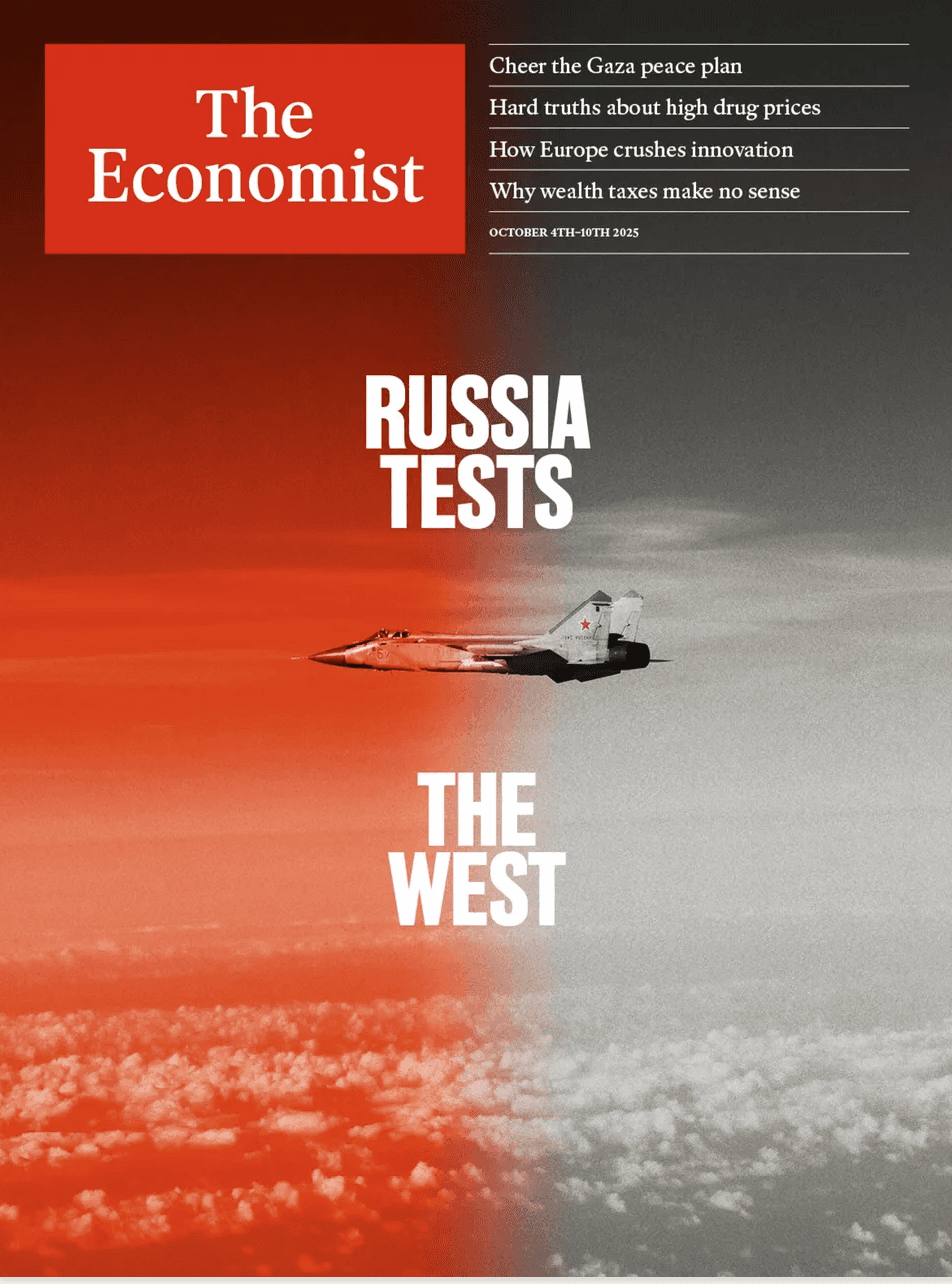
Source: The Economist, cover of 4 to 10 October 2025.
Notes
[1] Solikamsk Magnesium Works, a plant in Solikamsk in the Perm region of Russia that processes loparite ore into rare earth chloride and carbonate. It supplied Sillamäe from at least the 1990s.
[2] LREC: light rare earth concentrate, the mixed feed from which the plant separates cerium, lanthanum, neodymium and praseodymium.
[3] SX: solvent extraction, the chemical process that separates the rare earths from each other. Neo calls the Sillamäe separation plant "Silmet SX".
References
AS Molycorp Silmet. (2010). Majandusaasta aruanne 2010 [Annual report 2010]. Estonian e-Business Register.
AS Silmet. (2003). Majandusaasta aruanne 2003 [Annual report 2003]. Estonian e-Business Register.
AS Silmet. (2005). Majandusaasta aruanne 2005 [Annual report 2005]. Estonian e-Business Register.
AS Silmet. (2007). Majandusaasta aruanne 2007 [Annual report 2007]. Estonian e-Business Register.
AS Silmet. (2009). Majandusaasta aruanne 2009 [Annual report 2009]. Estonian e-Business Register.
Molycorp Silmet AS. (2011). Majandusaasta aruanne 2011 [Annual report 2011]. Estonian e-Business Register.
Molycorp Silmet AS. (2012). Majandusaasta aruanne 2012 [Annual report 2012]. Estonian e-Business Register.
Molycorp Silmet AS. (2015). Majandusaasta aruanne 2015 [Annual report 2015]. Estonian e-Business Register.
Neo Performance Materials. (2017, November 30). Final long form prospectus: Initial public offering [Prospectus].
Neo Performance Materials. (2018, April 23). China's Patent Re-Examination Board of SIPO rules in favor of Neo Performance Materials in invalidating patent claims of Rhodia Operations [Press release]. https://www.neomaterials.com/sipo-neo-rhodia-operations/
Neo Performance Materials. (2021a, March 22). Annual information form for the year ended December 31, 2020 [Annual information form].
Neo Performance Materials. (2021b, July 7). Energy Fuels and Neo Performance Materials announce contract signing and launch of commercial shipments of rare earth product to Europe in emerging U.S.-based rare earth supply chain [Press release]. https://www.neomaterials.com/energy-fuels-and-neo-performance-materials-contract/
Neo Performance Materials. (2021c, August 11). Management's discussion and analysis: Second quarter 2021 [Interim report].
Neo Performance Materials. (2021d, November 8). Management's discussion and analysis: Third quarter 2021 [Interim report].
Neo Performance Materials. (2021e, March 19). Management's discussion and analysis: Year ended December 31, 2020 [Annual report].
Neo Performance Materials. (2021f, March 1). Neo Performance Materials and Energy Fuels announce joint launch of U.S.-European rare earth production initiative [Press release]. https://www.neomaterials.com/neo-performance-materials-energy-fuels-rare-earth-production/
Neo Performance Materials. (2022a, May 12). Management's discussion and analysis: First quarter 2022 [Interim report].
Neo Performance Materials. (2022b, March 9). Management's discussion and analysis: Year ended December 31, 2021 [Annual report].
Neo Performance Materials. (2022c, November 9). Neo to receive grant under Europe's Just Transition Fund [Press release]. https://www.neomaterials.com/neo-performance-materials-european-grant/
Neo Performance Materials. (2023a, March 29). Annual information form for the year ended December 31, 2022 [Annual information form].
Neo Performance Materials. (2023b, May 10). Management's discussion and analysis: First quarter 2023 [Interim report].
Neo Performance Materials. (2023c, August 10). Management's discussion and analysis: Second quarter 2023 [Interim report].
Neo Performance Materials. (2023d, April 24). Neo Performance Materials and Hudson Resources advance the Greenland Sarfartoq rare earth project after receiving government approval for license transfer [Press release]. https://www.neomaterials.com/hudson-resources-greenland-sarfartoq-transfer/
Neo Performance Materials. (2024a, May 9). Management's discussion and analysis: First quarter 2024 [Interim report].
Neo Performance Materials. (2024b, August 8). Management's discussion and analysis: Second quarter 2024 [Interim report].
Neo Performance Materials. (2024c, November 13). Management's discussion and analysis: Third quarter 2024 [Interim report].
Neo Performance Materials. (2024d, March 14). Management's discussion and analysis: Year ended December 31, 2023 [Annual report].
Neo Performance Materials. (2024e, August 20). Neo announces agreement to sell majority equity interest of China rare earth separation assets for USD $30 million in cash [Press release]. https://www.neomaterials.com/neo-announces-agreement-to-sell-majority-equity-interest/
Neo Performance Materials. (2025a, March 18). Fourth quarter 2024 earnings call [Transcript].
Neo Performance Materials. (2025b, September 18). Investor Day 2025 [Slide presentation].
Neo Performance Materials. (2025c, May 8). Management's discussion and analysis: First quarter 2025 [Interim report].
Neo Performance Materials. (2025d, March 18). Management's discussion and analysis: Year ended December 31, 2024 [Annual report].
Neo Performance Materials. (2025e, June 18). President von der Leyen presents Neo's made-in-Europe permanent magnet to G7 leaders' summit [Press release]. https://www.neomaterials.com/president-von-der-leyen-presents-neos-magnet/
Neo Performance Materials. (2026a, May 12). First quarter 2026 earnings call [Transcript].
Neo Performance Materials. (2026b, March 19). Fourth quarter 2025 earnings call [Transcript].
Neo Performance Materials. (2026c, May 11). Management's discussion and analysis: First quarter 2026 [Interim report].
Neo Performance Materials. (2026d, March 19). Management's discussion and analysis: Year ended December 31, 2025 [Annual report].
Neo Performance Materials. (2026e, September 14). Neo Performance Materials advances to commercial production at its European magnet facility [Press release]. https://www.neomaterials.com/neo-advances-commercial-production-magnet-facility/
Neo Performance Materials. (2026f, August 31). Neo Performance Materials partners with Carester to advance its European rare earth supply chain [Press release]. https://www.neomaterials.com/neo-partners-with-carester/
Neo Performance Materials. (2026g, January 2). Neo Performance Materials reaches settlement in European patent litigation [Press release]. https://www.neomaterials.com/neo-performance-materials-reaches-settlement-in-european-patent-litigation/
Neo Performance Materials. (2026h, September 24). Neo Performance Materials signs MOU with Rainbow Rare Earths for magnet rare earth offtake from the Phalaborwa project [Press release]. https://www.neomaterials.com/neo-performance-materials-signs-mou-with-rainbow-rare-earths-for-magnet-rare-earth-offtake-from-the-phalaborwa-project/
NPM Narva OÜ. (2024, June 10). Keskkonnaloa taotlus T-KL/1020639-2 [Environmental permit application]. Estonian Environmental Board, KOTKAS register.
Rofer, C. K., & Kaasik, T. (Eds.). (1999). Turning a problem into a resource: Remediation and waste management at the Sillamäe site, Estonia [Conference proceedings, NATO Advanced Research Workshop, Tallinn, October 5–9, 1998]. https://digital.library.unt.edu/ark:/67531/metadc723382/m2/1/high_res_d/785026.pdf
Veridica. (2023, July 16). The Estonian Northeast is moving the economy to a European footing. https://www.veridica.ro/en/opinions/the-estonian-northeast-is-moving-the-economy-to-a-european-footing
Published by House of Hōma OÜ, registered in Estonia.
